Town Manager Joe Devine recently presented an overview of how Tuscan Village has expanded Salem’s tax base and helped reduce the amount that would otherwise need to be raised from the Town’s remaining property owners.
Tuscan Village has grown into one of Salem’s most significant mixed-use districts, featuring apartments, condominiums, medical offices, a hotel, restaurants, retail businesses and additional development still underway. The district includes major properties such as Mass General Hospital’s medical offices, Hanover, Corsa and Caro apartments, The Artisan Hotel, Tavern in the Square and the future Whole Foods Market.
According to the Town of Salem Assessing Department, the combined assessed value of Tuscan Village properties increased from approximately $31 million in 2021 to more than $463 million in 2025. That growth has resulted in a substantial increase in annual property tax revenue.
Nearly $9.9 Million Generated in 2025
Tuscan Village properties generated approximately $9.87 million in property tax revenue in 2025, representing an increase of approximately 85 percent since 2022.
Of that amount, approximately $1.58 million was generated by residential condominium owners who are themselves Salem taxpayers. Overall, Tuscan Village accounts for an estimated 7.3 percent of Salem’s total property tax levy despite occupying only a small portion of the community.
The Town Manager explained that this additional assessed value helps spread the community’s tax obligation across a broader tax base. Without the revenue generated by Tuscan Village, the same overall tax levy would need to be collected from Salem’s remaining taxpayers.
Based on the Town’s analysis, the 2025 tax rate could have been approximately $19.73 per $1,000 of assessed value without Tuscan Village, compared with the actual 2025 rate of $18.16.
For a home assessed at approximately $430,000, the difference is estimated at approximately $675 annually. This does not mean Tuscan Village directly reduces an individual property tax bill each year. Rather, its contribution helps prevent tax bills from being higher than they otherwise would be.
What Every $1 of Tuscan Tax Pays For
Tuscan Village generated $9,874,914 in property tax revenue in 2025. Here is where every dollar went:
- 55.4 cents went to Local Schools, totaling $5,475,792 for the Salem School District operating budget.
- 32.5 cents went to Town Services, totaling $3,208,260 for roads, fire, police, parks and infrastructure.
- 7.8 cents went to State Education, totaling $766,720 remitted to the State of New Hampshire for statewide education funding.
- 4.3 cents went to County services, totaling $424,143 for Rockingham County services.
Of the 32.5 cents that supports Town services, approximately 13.0 cents supports police and fire, 8.1 cents supports roads and DPW, 6.5 cents supports administration, and 4.9 cents supports parks and recreation.
Does the Development Create Additional Costs?
The Town Manager also addressed whether Tuscan Village creates additional demand for municipal and school services.
The development generates service needs, including police and fire responses, road use, infrastructure maintenance and additional students within the Salem School District. However, the Town’s analysis indicates that the revenue generated by the development exceeds its estimated proportional service costs.
For example, Tuscan Village contributes approximately $5.48 million annually to local education. The presentation estimated that approximately 50 students have been added to the school system from the development, representing an estimated annual educational cost of approximately $750,000 based on an average cost of $15,000 per student.
Tuscan Village also contributes an estimated $1.28 million toward police and fire services and more than $800,000 toward roads and public works. The development also funded significant private infrastructure improvements during construction.
Why Have Property Taxes Continued to Increase?
Although Tuscan Village has added substantial value to Salem’s tax base, other costs continue to place upward pressure on the overall property tax rate.
The local school portion represents more than half of the property tax bill and is established separately through the School District’s budget process. State education and Rockingham County obligations also fall outside the Town’s direct control.
Municipal expenses, including public safety, road construction, equipment, utilities, employee compensation and other services, have also increased due to inflation and growing service demands.
Tuscan Village helps offset those increases by absorbing a growing share of the tax levy. As new buildings are completed and properties reach their full assessed value, the development’s contribution is expected to continue increasing.
The Town Manager emphasized that the appropriate question is not simply why taxes have not declined, but how much higher they could have been without the growth in Salem’s commercial and mixed-use tax base.
Continued Growth Ahead
Several Tuscan Village properties are still under development or have not yet reached their full assessed value. As additional residential, retail and commercial spaces are completed, the district is expected to generate additional property tax revenue.
The Town will continue monitoring the development’s assessed value, tax contribution and impact on municipal services.
Tuscan Village demonstrates how commercial and mixed-use development can help diversify Salem’s tax base, support public services and reduce the portion of the overall tax burden that would otherwise fall upon existing property owners.
Watch the Presentation and Review the Report
Residents can learn more by watching Town Manager Joe Devine’s full presentation through Salem Community Television and reviewing the complete Tuscan Village Tax Impact Report.
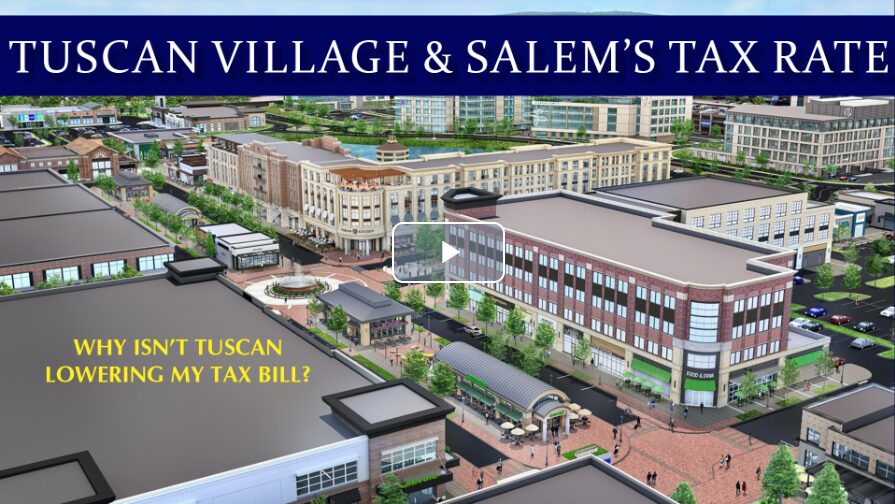
Watch the SCTV recording:
Watch the full Town Manager presentation
View the PowerPoint presentation:
View the Tuscan Village Tax Impact Report